You can choose one paint color, use it on three different surfaces, and end up with three noticeably different results.
The formula has not changed.
The sheen has.
That matters because we do not experience color independently from light. We see color on a surface, and the way that surface absorbs or reflects light changes what our eye perceives.
The Color Stays the Same. The Reflection Does Not.
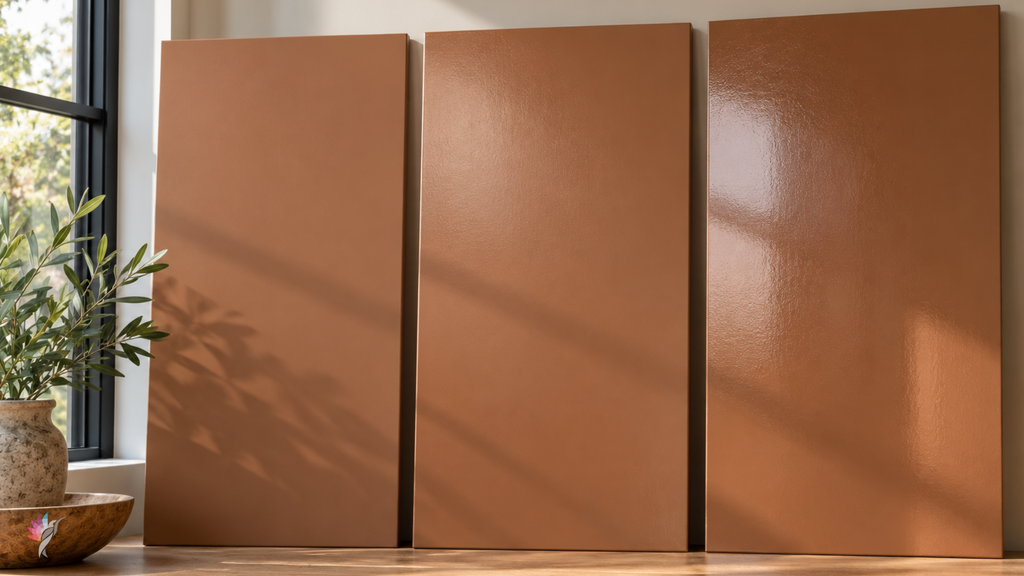
Imagine using the same color in three finishes:
- matte on the walls
- satin on a door
- semi-gloss on the trim
Technically, the paint color may be identical.
Visually, it will not behave the same way.
Matte reflects very little light, so the color often appears softer, quieter, and more uniform.
Satin catches more light. The same color may appear slightly clearer or more pronounced as you move through the room.
Semi-gloss reflects even more. Highlights become stronger, edges become more noticeable, and the color can appear brighter or deeper depending on the angle of the light.
Nothing happened to the color formula.
What changed was the relationship between the surface, the light, and your eye.
Matte: The Quietest Version
Matte allows you to experience more of the color and less of the reflection.
Because very little light bounces directly off the surface, the color can feel soft and visually settled.
On a large wall, this can create a more continuous field of color. There are fewer obvious highlights interrupting what you see.
That becomes particularly noticeable with medium and deeper colors. A matte surface can allow the color to feel substantial without constantly reflecting windows, lamps, or other bright areas of the room.
Satin: More Light Enters the Conversation
Move that same color into satin and the surface begins interacting more visibly with the light.
Stand directly in front of it and the difference may seem small.
Move sideways, turn on a lamp, or let afternoon sun strike the surface, and the change becomes easier to see.
Certain areas may look lighter because they are reflecting light toward you. Other areas may appear deeper by comparison.
This is one reason a color can seem slightly different from one wall to another even when it came from the same paint can.
The light is not hitting every surface in the same way.
Semi-Gloss: Reflection Creates Definition
Semi-gloss makes that interaction even more obvious.
This is why painting trim, molding, or doors in the same color as the walls does not necessarily make the architecture disappear.
Quite often, the opposite happens.
The wall may remain quiet in matte while semi-gloss molding catches the light along its edges. The architectural detail becomes visible through reflection instead of contrast.
You have not introduced another color.
You have introduced another way for light to interact with the same color.
Sheen Can Change Apparent Color
This is where sheen becomes more important than many homeowners expect.
A more reflective surface can make a color appear:
- brighter where it catches light
- deeper from another viewing angle
- more pronounced under directional lighting
- less visually uniform across a large surface
The effect will not be identical in every room.
A satin finish beside a large window may reveal far more reflection than the same finish in a softly lit hallway.
A semi-gloss door underneath recessed lighting may look noticeably more intense than the matte wall beside it.
The paint did not suddenly become a different color.
You are seeing reflected light layered over the color.
One Color Can Still Create Depth
This is one of my favorite reasons to think about sheen intentionally.
A room does not always need additional paint colors to create interest.
One color used in several finishes can establish hierarchy very quietly.
The matte wall becomes the background.
The satin door catches a little more light.
The semi-gloss trim defines the architecture.
The palette remains connected, but it does not feel flat.
The variation comes from reflection rather than another hue.
Look at Sheen in the Actual Light
When you are choosing a finish, do not evaluate it only from directly in front of the wall.
Walk around.
Look from the side.
Notice what happens when daylight moves across it.
Turn on the lighting you actually use in the evening.
A finish that looks understated from one angle can become much more reflective from another.
That is especially important on long walls, doors, trim, and architectural details where light may strike the surface at an angle.
The Better Question
We spend a great deal of time asking:
What color should this be?
But there is another question worth asking:
How do I want this color to respond to light?
That one decision can change how soft, defined, quiet, or visually active the color feels.
The paint color may be exactly the same.
The experience of it may not be.
Final Thought
Color does not live on a paint chip.
It lives on a surface, in a room, under changing light.
That is why sheen should never be treated as a minor decision made after the color has been selected.
Matte, satin, and semi-gloss can each reveal a different side of the same color.
And sometimes one color is all you need.
Ready to take the next step?
You can book an appointment with me for personalized support or schedule a discovery call if you’d like to explore how I can help.
Enjoy this blog?